
Synthetic results
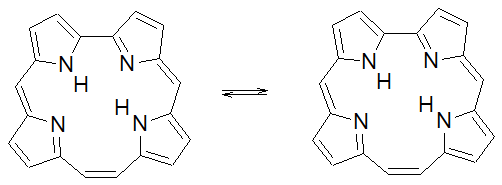
This porphyrin isomer has been obtained so far only in the functionalized form. Our goal was to obtain parent, unsubstituted corrphycene, as it is predicted by calculations to provide an ideal model of a so-called "soft" chromophore. Spectral and photophysical properties of such species are extremely sensitive to both intra- and intermolecular perturbations. We expect that a soft chromophore will provide a good model for studying the influence of a cavity on the electronic structure, the electronic spectra, as well as on photophysics, and, in consequence, reactivity (tautomerism).
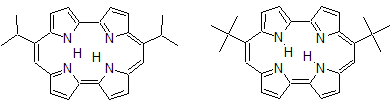
Switching from isopropyl to tert-butyl substituents has a huge impact on the photophysical properties. The isopropyl derivative emits strongly, whereas the tert-butyl derivative has an extremely low fluorescence quantum yield and short decay time. According to calculations, this is related to twisting in the excited electronic state. We expect that placing this molecule in a cavity may affect the barrier to twisting and thus it should alter the photophysics.
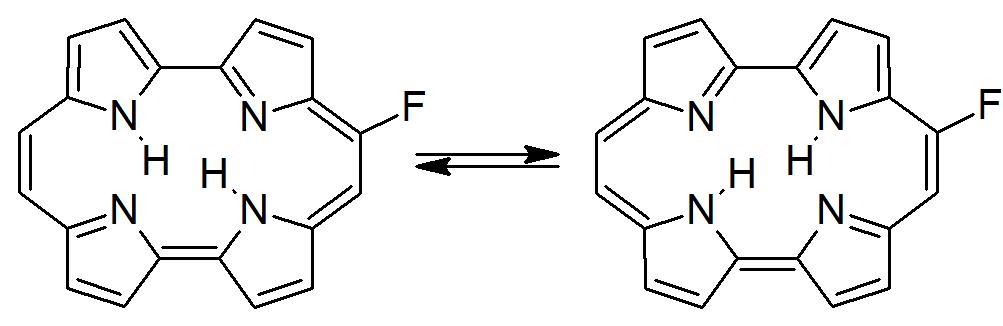
Substitution with fluorine at specific positions lowers the symmetry and lifts the double degeneracy of tautomeric forms. This effect can be detected by the appearance of absorption bands of both tautomeric forms. Due to difference in energies, one of the form dominates the spectra. Our goal is to check whether we can reverse the energy difference between the tautomers by selectively tuning the cavity to the transition in the higher energy form.


